
Carpenter Ants or Termites? How to Tell in Your Alabama Home
Both leave you wood that is not solid anymore. One is a moisture problem that happens to involve an insect; the other is a structural problem with a colony behind it. Telling them apart in five minutes changes what you do next.
The window sill is soft. The trim by the back door crumbles when you press it. Something is eating wood, and the two candidates in Alabama are carpenter ants and subterranean termites. They get confused constantly, including by people who should know better, and the confusion matters: a carpenter ant problem is fixed by fixing a leak; a termite problem is fixed by treating a colony you cannot see. Here is how to tell them apart with what is in front of you.
Look at the damage first
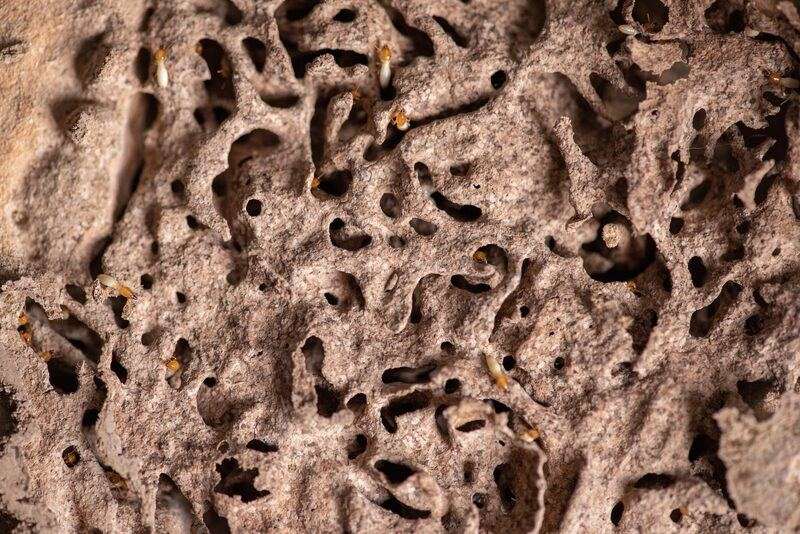
Carpenter ants do not eat wood. They excavate it to nest in, and they only nest in wood that is damp or was damp — around a leaking window, under a failed flashing, a deck ledger, a bathroom subfloor. Their galleries are smooth and clean, almost sanded, and they push the debris out. That debris is the tell: small piles of fine, dry shavings, often mixed with insect parts, below a slit in the wood. Subterranean termites eat the wood. Their galleries run along the grain in layers, and they are packed with dried mud and a moist, gritty residue. There is no clean sawdust, ever. If you see mud, it is termites.
Look at the insect
A carpenter ant is a large black or reddish-black ant with a pinched waist and elbowed antennae. Termite workers are small, soft, cream-colored, and you almost never see them in the open. The confusion usually comes in spring, when both send out winged reproductives. A flying carpenter ant has a narrow waist and front wings longer than the back ones; a termite swarmer has a straight, thick body and four wings all the same length. Piles of identical shed wings on a windowsill are termites. We cover the full swarmer identification in how to identify termites.
Look at the timing and place
Carpenter ants forage at night and you may see one or two big ants on the kitchen counter in spring and summer, usually near a bathroom or an exterior wall with a moisture history. Termites give you mud tubes: pencil-width tunnels of soil running up a foundation wall, a pier, or a plumbing penetration. A mud tube is diagnostic; nothing else in Alabama builds one.
Why the fix is different
Carpenter ants are treated as part of a regular pest program, but the treatment does not last if the moisture stays — find the leak, dry the wood, and the colony has no reason to be there. It is a repair problem with an insect attached. Termites are a colony in the soil, possibly a hundred feet from the house, and Alabama requires licensed treatment: either a bait system the colony carries back and feeds on, or a treated zone in the soil around the whole foundation. It starts with a free WDO inspection and it carries an agreement, because the protection is ongoing.
If you are not sure
Take a clear photo of the damage and of the insect if you have one, leave the mud tube or the frass in place, and let an inspector look. Do not spray the tube and do not tear out the trim. Carpenter ants are covered under the bi-monthly pest plan; termites are handled under a separate Sentricon® agreement with up to $1,000,000 in EnviroCare damage repair coverage on qualifying homes, subject to the terms of the agreement. Either way, the inspection costs nothing.
Call the office nearest you — Birmingham (205) 991-2882, Alabaster (205) 940-6360, Lake Martin / Alex City (256) 234-6162, or Huntsville (256) 937-7676 — or request a free quote and we will take it from there.
No One Cares Like EnviroCare.
Ready to Schedule?
Call the EnviroCare office nearest you.