
How Long Does Sentricon Take to Work? What Alabama Homeowners Should Expect
A bait system works on a different clock than a spray. How Sentricon works, a realistic timeline for an Alabama home, what speeds it up or slows it down, and what you will and will not see.
Once the Sentricon® stations are in the ground, the next question is fair: how long does this take to work? The honest answer is that a bait system works on a different clock than a spray, and it is supposed to. Here is how the system works, what a realistic timeline looks like for an Alabama home, what speeds it up or slows it down, and what you should and should not expect to see along the way.
How the Sentricon system works, and why it is not instant
Subterranean termites forage through the soil all the time, looking for cellulose. Sentricon termite bait stations are installed in the ground around the perimeter of the house, spaced to sit in that termite foraging path. Worker termites that find a station feed on the bait and carry it back to the colony, where it is passed along to other termites. The active ingredient works slowly on purpose: it has to move through the colony before it takes effect, so the workers keep feeding and keep sharing instead of dying on the spot. The goal is the colony itself, not just the termites that happen to cross a treated line; Sentricon is labeled for colony elimination of subterranean termites.
With Sentricon Always Active™ technology, every bait station contains bait from the day the stations are installed. There is no waiting for termites to find an empty monitor first.
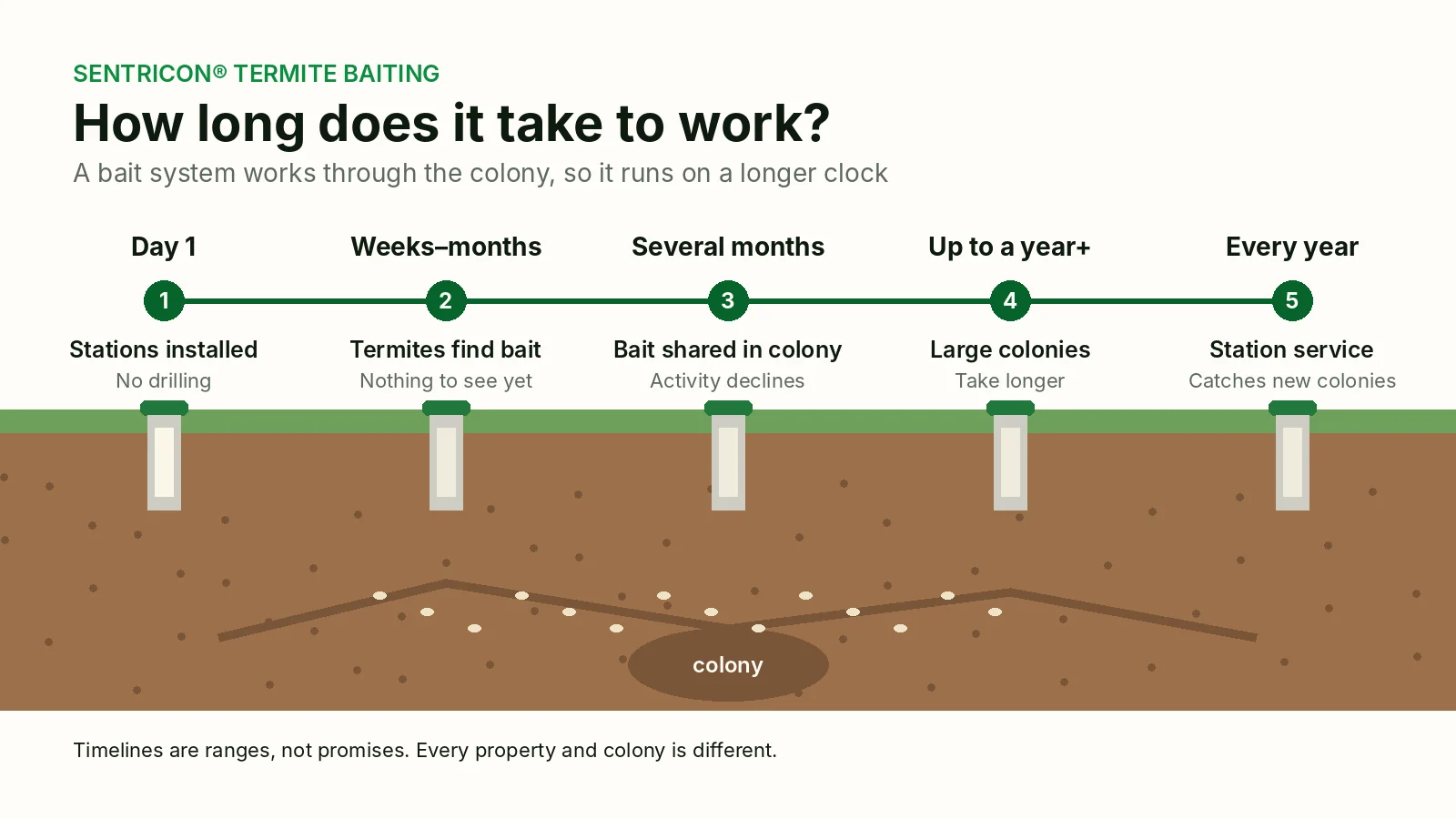
How long does Sentricon take to work? A realistic timeline
- Day one. Sentricon stations are installed around your home, with no drilling through slabs, patios or driveways.
- First weeks to months. Foraging termites will find the bait stations and start feeding. Nothing changes that you can see; this is the bait being distributed.
- Several months. Where termites have been feeding, activity typically declines. A small colony close to the house can show results within a few months.
- Up to a year or more. Large colonies, colonies foraging from a distance, or several colonies on one lot can take longer.
- Every year after. The stations stay in the ground and are serviced on schedule, because a new colony can move into the same territory.
Many pest control companies will tell you the same thing: termite baiting can take several months. Treat any timeline as a range, not a promise. Every property and every colony is different, and your technician will tell you what they are seeing at your house.
What affects how fast it works
Colony size and distance
A small colony foraging near the foundation responds faster than a large, established colony feeding from across the yard. Formosan termites, which are established along Alabama's Gulf Coast, build much larger colonies than the Eastern subterranean termites we find across central and north Alabama, and larger colonies take longer.
Soil temperature and season
Termites forage less in cold soil. Alabama winters are mild, so activity slows in December and January rather than stopping, and feeding picks up in spring and through the warm months. The stations keep working year-round either way.
How many termite colonies are on the property
A lot near a creek, a wooded edge or a drainage area can have more than one colony foraging under it. Each one has to find the Sentricon bait, and the bait stations around the perimeter are spaced so that they can.
Conditions around the house
Wood touching soil, mulch piled against siding, leaking spigots and wet crawl spaces all make a house more attractive to termites. Fixing those helps the program and is worth doing regardless. If there is a previous termite problem or active termite infestation in the structure, the technician will tell you whether anything beyond the bait stations is needed.
What you will, and will not, see
Signs of termite activity to keep watching for
While the stations work, keep an eye out for the same signs of termite activity as always: mud tubes on the foundation, a swarm of winged termites in spring, shed wings on a windowsill, or wood that sounds hollow. Any of those means a call to us, not a can of spray.
What the technician sees
Most homeowners never see the system working, and that is normal. What the technician looks for on each service visit is bait consumption in the stations and, over time, a drop in foraging activity. The outcome you are protecting is no termite activity in the structure, and the service visits are how that is checked.
If you see termites or mud tubes inside the house while the stations are in place, call us. Do not spray them yourself: disturbing active termites can break up the feeding that the bait depends on. Our guide to identifying termites helps you tell a swarm of termites from flying ants first.
Monitoring and maintenance: what the service visits involve
The Sentricon system is not install-and-forget; continuous monitoring is the point. On a schedule, a pest control technician checks every station, looks for signs of feeding and for foraging between stations, replaces bait as needed, and notes conditions around the house that invite termites. The green caps you see flush with the lawn are those stations; our post on green caps in the yard explains what they are.
Sentricon bait stations vs. liquid barrier treatments
Liquid treatments and termite bait systems are both established approaches to termite control and they work differently. A liquid termiticide is applied to the soil around the structure and acts quickly on termites that cross it; a bait system takes longer and works through the colony's own feeding. Which fits depends on the house, its construction and how much activity is already present. We compare them side by side in Sentricon vs. liquid termite treatment, and our Sentricon cost and value guide covers what the program includes.
Common questions
Can I see the stations in my yard?
Yes. They sit flush with the ground with a small cap on top. Your technician will show you where they are at installation.
Will installation tear up my landscaping?
No. Stations are set into the soil at intervals around the house. There is no trenching along the foundation and no drilling through concrete.
Does Sentricon work on Formosan termites?
Yes. Sentricon is labeled for subterranean termites, including Formosan termites. Because their colonies are larger, it can take longer.
How long do I keep the stations in?
For as long as you want the house protected. Even after a colony is gone, a new one can move into the same ground, and the stations are how that gets caught early. Termite protection is ongoing. Renewal keeps monitoring of every bait station in place, and for qualifying homes it keeps up to $1,000,000 in termite damage repair coverage provided by EnviroCare in place, subject to the terms of the agreement.
Do I need an inspection first?
Yes. Every termite control program starts with a free termite inspection by one of our Certified Sentricon Specialists, so the station layout fits the house and any current activity is documented. The program is quoted in writing after that inspection, never over the phone.
Schedule a free termite inspection
The Wedgworth family has been doing professional pest control and protecting Alabama homes since 1958, now in its fourth generation. Call the office nearest you: Birmingham (205) 991-2882, Alabaster (205) 940-6360, Alexander City and Lake Martin (256) 234-6162, or Huntsville (256) 937-7676. Or request a free quote online.
No One Cares Like EnviroCare.
Ready to Schedule?
Call the EnviroCare office nearest you.