
The Hidden Dangers of Mosquitoes in Alabama — and What Actually Lowers the Risk
Most mosquito bites in Alabama are an itch and nothing more. A small number are not. West Nile, Eastern equine encephalitis, and La Crosse virus are all reported in this state, and heartworm threatens every unprotected dog in it. Here is what the real risks are, which mosquitoes carry them, and what makes a measurable difference in your yard.
A mosquito bite is, almost always, just a bite. It itches, it fades, and by the next evening on the back porch you have forgotten it. But Alabama is a warm, wet state with a nine-month mosquito season, and a handful of the viruses those mosquitoes carry are reported here every year. We are not in the business of scaring people about their own yards. We are in the business of telling them what is real. This is what is real about mosquitoes in Alabama, and what actually lowers the odds.
Which mosquito-borne illnesses occur in Alabama?
West Nile virus is the most commonly reported mosquito-borne disease in Alabama, with human cases confirmed by the state health department most years, typically from mid-summer into October. The large majority of people infected never notice. Roughly one in five develops a fever with headache, body aches, and fatigue. A small fraction — well under one percent — develop the serious neurological form, and that risk rises with age and with certain medical conditions. The carrier is the Culex mosquito: the plain brown one that bites at dusk and dawn and breeds in stagnant, organically rich water like a neglected birdbath, a clogged gutter, or a storm drain.
Eastern equine encephalitis (EEE) is rare — Alabama sees only occasional human cases — but it is the most serious of the group when it does occur. It is carried by mosquitoes associated with freshwater hardwood swamps and wet woodlands, which describes a great deal of the land around Lake Martin and the river bottoms across the state. Horses are affected far more often than people, which is why the disease shows up in the news after a veterinary case.
La Crosse encephalitis is carried by the eastern treehole mosquito and primarily affects children under sixteen. It is reported most in the southern Appalachians, including north Alabama and the Tennessee Valley around Huntsville. The breeding site is exactly what the name says: water held in tree holes, and in the artificial equivalent — old tires, buckets, and tarps in wooded yards.
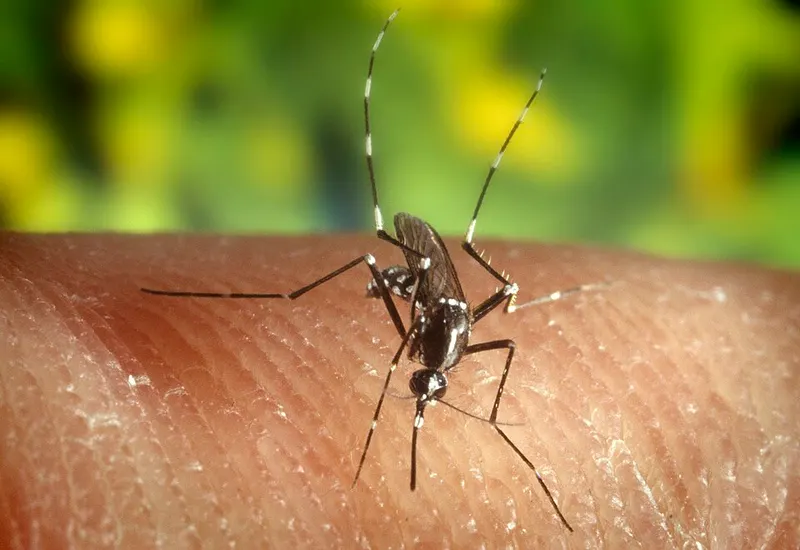
Dengue, Zika, and chikungunya are carried by Aedes aegypti and Aedes albopictus, the black-and-white striped day-biting mosquitoes, both of which live in Alabama. Cases here are almost always in travelers who were infected elsewhere; local transmission is possible but has not been a sustained problem in this state. The Asian tiger mosquito that bites your ankles at noon is the Aedes albopictus, and it is the most common nuisance mosquito in every subdivision from Hoover to Madison.
Heartworm is the one that affects the most households in Alabama. It is a parasite, not a virus, transmitted to dogs (and less often cats) by a mosquito bite, and Alabama is consistently among the highest-risk states in the country. Every unprotected dog that spends time outdoors is at risk. The prevention is year-round veterinary medication, not yard treatment — but reducing the mosquitoes in the yard reduces the exposure.
What are the symptoms worth acting on?
We are pest control, not physicians, so this is deliberately general: for most people a mosquito bite needs nothing. If a fever, severe headache, stiff neck, confusion, or unusual drowsiness develops within about two weeks of heavy mosquito exposure, particularly in late summer, that is worth a call to a doctor and worth mentioning the mosquito exposure. In children in north Alabama, the same applies for La Crosse. Take questions about your own health to a medical professional; the state health department publishes current case information each season.
Which precautions make a measurable difference?
Most of the risk is concentrated in a few habits, and they are within reach of every homeowner.
1. Dump the water. All of it. Weekly.
Every mosquito in your yard was born in standing water, and the disease-carrying species prefer small containers, not the lake. A mosquito needs about a teaspoon. The saucer under the flowerpot, the tarp over the grill, a kids' toy in the flowerbed, the low corner of a gutter, a bird bath that has not been refilled, a wheelbarrow, a bucket by the hose. Tip them, scrub them, and do it every week because the life cycle from egg to biting adult can run a week in July heat. This single habit removes more mosquitoes than anything you can buy.
2. Treat the shade, not the air
Adult mosquitoes do not hover in the open during the day. They rest on the underside of leaves, in ivy beds, in tall grass, under decks, and along the shaded foundation line. That is where a professional barrier application does its work — a residual treatment on the resting surfaces, so the mosquitoes that land there over the following weeks do not get up again. Broadcasting product into the open air does nothing. We explain how the treatment cycle works in yard sprays vs. professional mosquito service.
3. Repellent when it matters
An EPA-registered repellent — DEET, picaridin, or oil of lemon eucalyptus, used as the label directs — on exposed skin during dusk, dawn, and in wooded areas is the personal-protection layer. Long sleeves and pants at dusk help. This is the step that protects you at the ballfield and on the boat, where yard treatment cannot reach.
4. Screens, doors, and the porch fan
Intact window screens, a door that closes behind you, and a ceiling fan on the porch. Mosquitoes are weak fliers; a fan on medium keeps most of them off the seating area, which is why it is the cheapest mosquito control there is.
5. Heartworm prevention for the dog
Year-round, from the veterinarian. Not seasonal, not "just in summer." Alabama winters are too mild to give a reliable break.
What professional mosquito service can and cannot do
We will be plain about this because some companies are not. A professional yard program knocks the mosquito population in your yard down substantially and keeps it down through the season, treatment after treatment. It does not get rid of every mosquito in an Alabama yard, and anyone promising that is selling you something. Mosquitoes fly in from the neighbor's gutter and the drainage ditch down the street; a treated yard has far fewer, not none. That reduction is exactly what lowers bite count and, with it, exposure.
EnviroCare's seasonal mosquito service runs from spring through fall, treating the resting and breeding zones around the home on a monthly cycle, with tick and chigger coverage available as an add-on for wooded lots. Pricing and plan options are on our pricing page. We never guarantee elimination, and we would rather you know that on day one.
The short version
The serious risks are real but uncommon; heartworm is common and preventable; and the household habits — dump the water, treat the shade, use repellent at dusk — do most of the work. If you would like the yard side of that handled on a schedule, we are glad to walk the property with you and show you where the water is hiding.
Call the office nearest you — Birmingham (205) 991-2882, Alabaster (205) 940-6360, Lake Martin / Alex City (256) 234-6162, or Huntsville (256) 937-7676 — or request a free quote and we will take it from there.
No One Cares Like EnviroCare.
Ready to Schedule?
Call the EnviroCare office nearest you.