
Spiders on Boat Docks at Lake Martin: What Lives There and What Keeps Them Down
Docks and boathouses are spider country: damp wood, dark gaps and lights that pull in insects. Which spiders you will find on a Lake Martin dock, what home remedies really do, and what keeps the numbers down.
If you have ever walked down to the dock at Lake Martin first thing in the morning and caught a web across the face, you already know docks are spider country. Wood that stays damp, dark gaps under the decking, pilings and crossbeams to anchor silk to, and a light on the boathouse that pulls in insects every night. Where the bugs collect, spiders follow. Here is what lives on a lake dock, whether the DIY ways to get rid of spiders actually work, and what keeps the spider population down and spiders off your boat through the season.
Why spiders pile up on boat docks
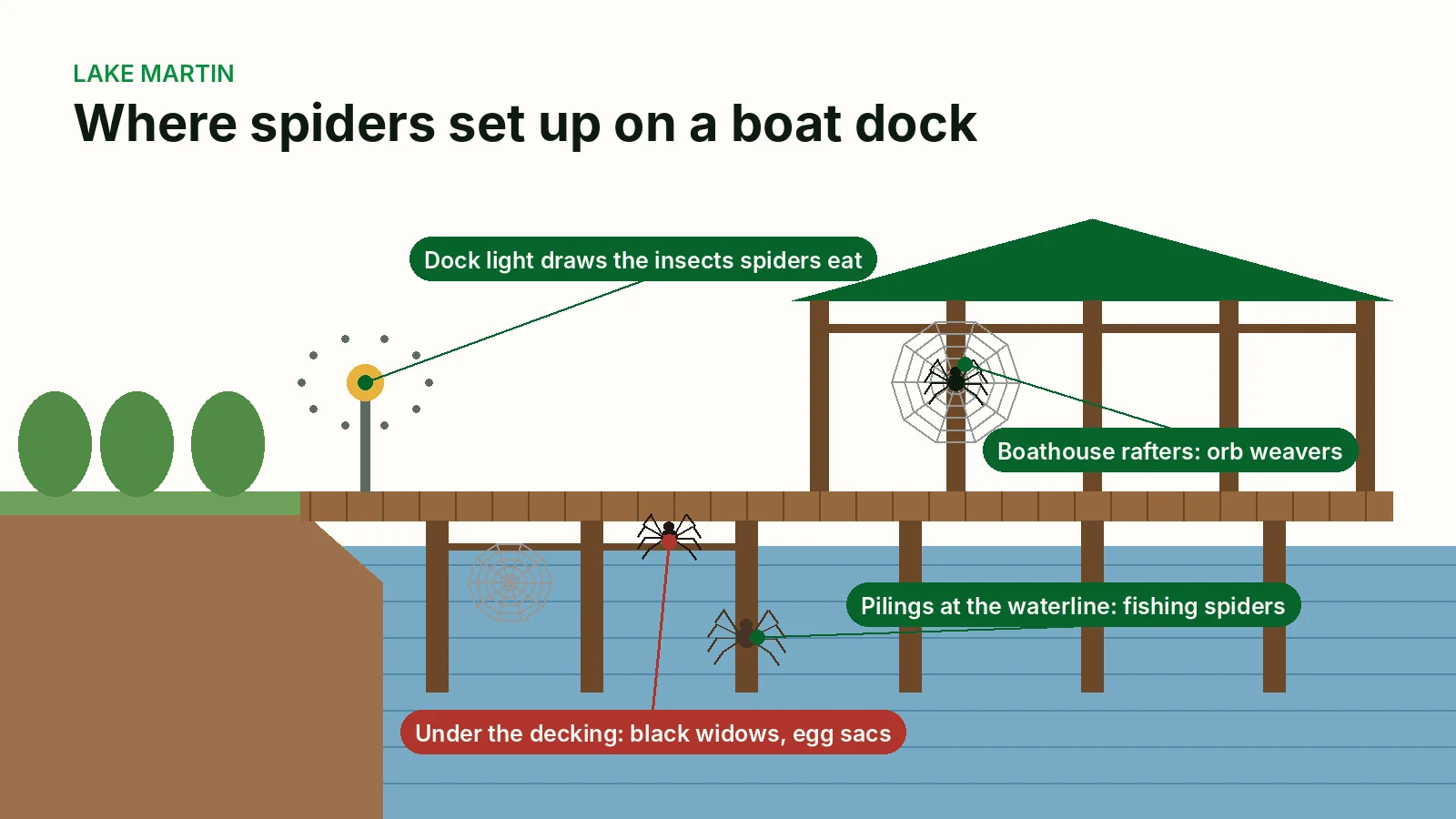
A dock gives spiders three things at once: shelter, moisture and a steady food supply. The underside of the decking stays shaded and humid, which is where egg sacs get tucked away. Pilings, crossbeams, ladder rungs, cleats and dock lines are anchor points for webs. Boathouse rafters trap warmth. And the insects that hatch along the shoreline, plus the moths and midges drawn to dock lights after dark, keep the spiders fed. A dock that only gets visited on weekends also goes five days at a time without anyone sweeping a spider web down. The black or white specks you find on the boat cover and the dock boards are spider poop, and they stain if they sit.
The same is true whether it is a private dock behind a lake house or a slip at a marina: the spiders travel on lines, on the breeze and on the boat itself, so a clean slip next to a dirty one does not stay clean for long.
The spiders you are most likely to find on a Lake Martin dock
- Orb weavers. The big round webs strung between posts and across the boat slip overnight. Alarming in size, harmless to people, and usually rebuilt every evening.
- Fishing spiders. Large, long-legged spiders that sit on pilings and the edge of the decking right at the waterline. They are often mistaken for wolf spiders and they can run across the surface of the water.
- Wolf spiders. Fast hunters on the deck boards and stairs at night. They do not build webs to catch prey and rarely bite unless pinned against skin.
- Black widows. The one that matters most. They build low, messy, irregular webs in dark protected spots: under the dock, inside the dock box, behind stored life jackets, under the lip of a kayak rack.
For more on that last one, see our guide to black widow spiders in Alabama.
Black widows: check before you reach
Most dock spiders are a nuisance. Black widows deserve attention, especially at a lake house where children and guests do not know to look before they grab a dock line, pull a tackle box out of a dark corner or slide a kayak out from under the dock. A few habits make a real difference: wear gloves when you open a dock box that has sat closed for a week, shake out life jackets and cushions before use, and keep stored items off the decking so there are fewer dark pockets to build in. If you are finding black widows regularly, that is a sign the harborage and the food supply both need attention, not just the spider you can see.
DIY ways to get rid of spiders on a dock: what works and what does not
Dryer sheets
A lot of boat owners use dryer sheets tucked into the cover or the cabin. The idea is that the scent keeps spiders from settling in. On a dock exposed to wind, sun and lake humidity, any effect is gone within a day or two. They are not a control method.
Peppermint oil
Spiders do seem to avoid strong mint odors for a short time. The problem is persistence: an oil spray on sun-baked boards evaporates or washes off fast, and nobody reapplies it every few days. Reasonable for a single weekend, not for a season.
Vinegar and moth balls
A spray bottle of diluted vinegar will kill a spider it soaks and wipes off webs, but it leaves nothing behind once it dries. Moth balls are a pesticide with their own label, they are not meant to be scattered outdoors, and they do not belong on a dock near the water or the aquatic life in it.
Over-the-counter sprays
A can of spider spray or an insecticide in a pump sprayer knocks down the spiders it hits. It does not reach the underside of the decking or the pilings, and it does nothing about the insects drawing spiders in. The next hatch comes out of the egg sacs you missed. Many consumer products are also not labeled for use over or next to water, so read the label before you spray any chemical on a dock. Rain, sun and spray off the lake wear down whatever residual a product has much faster than on a house.
What actually keeps dock spiders down
The lasting answer has two parts: less food and less shelter.
- Change the lights. White dock and boathouse lights pull in the moths and midges spiders eat. Warm yellow or amber bulbs attract far fewer insects. Put the light on a timer or a motion sensor so it is not on all night.
- Sweep webs down weekly. A long-handled brush along the rafters, posts and the underside of the railing. Removing webs and egg sacs regularly breaks the cycle.
- Keep spiders off your boat. Keep the cover snug, run a brush over the bimini and the cover frame before you take it off, and do not leave cushions or towels in the boat between weekends.
- Clear the clutter. Store cushions, life jackets, buckets and tackle in sealed bins rather than open on the decking.
- Trim the shoreline growth. Overhanging limbs and brush touching the dock or boathouse give spiders a bridge and give insects a resting place.
- Reduce the insect pressure around the property. Seasonal mosquito treatment for a lake house targets the shaded resting areas between the house and the shoreline, which cuts down part of what spiders feed on.
How EnviroCare handles spiders at a lake house
Our pest control program starts at the outside of the house: the foundation, eaves, windows, doors and the outbuildings, with webs knocked down along the eaves and treatment into the cracks and gaps where spiders and the insects they eat get in. At a lake property that includes the boat house and land-side structures, and the dock where the product label allows it. Any pesticide used near the water is chosen and applied according to label directions, which limit what can go on surfaces over or beside the lake; the technician stays off the water's edge itself. That is one more reason the habits above matter on a dock: they cover the places treatment cannot.
Routine service does not require anyone to be home, which is how most of our weekend lake-house customers work. Visits are scheduled around the property, and interior service can be set for a weekend you plan to be at the lake. See how the program works on our Lake Martin pest control page, and use the Lake Martin home pest checklist when you open the house in spring.
Spiders and termites like the same conditions
Damp wood, ground contact and little foot traffic draw spiders, and they draw subterranean termites too. Dock pilings and boathouse framing that meet the soil on the shore side are exactly where termites can work unnoticed. If you are calling about spiders, it is worth having the boathouse and the land end of the dock looked at during a free termite inspection. Termite work is quoted after that inspection, never over the phone.
Common questions
How soon can we use the dock after a treatment?
The product label sets the re-entry interval, and your technician will tell you how long to stay off treated areas before you go back out. Usually that is until the application has dried.
Will one treatment keep spiders off the dock all summer?
No, and we will not tell you it does. Spiders and insects keep arriving from the shoreline and the woods. Recurring service through the season, plus the light, web and clutter habits above, is what keeps the numbers down.
Do you treat inside the boathouse?
Yes. Boathouse rafters and corners are some of the busiest spots on a lake property for orb weavers, and they are part of a lake-house service visit where the label allows. Treating an active wasp or hornet nest is an add-on for pest customers at an additional charge.
We are only at the lake a few weekends a year. Does that matter?
No. Exterior service runs on schedule whether anyone is there or not.
Talk to the Lake Martin office
EnviroCare started as Wedgworth Pest Control in Alexander City in 1958, and the family is now in its fourth generation. The Alex City office at 1785 Tallapoosa Street covers Lake Martin, Dadeville, Eclectic and the communities around the lake. Call (256) 234-6162 or request a free quote.
No One Cares Like EnviroCare.
Ready to Schedule?
Call the EnviroCare office nearest you.